Vastu & Ayurveda
Vastu Architect & Astrologer Yogiraj Sri
The Connection Between Your Home and Your Health
WHAT DO WE VALUE MOST IN LIFE?
We may think of financial security, loving relationships, success, or peace of mind. But good health is the foundation that allows us to enjoy all of these things and live life fully.
Our homes can play an important role in supporting our everyday comfort and wellbeing. We spend a significant part of our lives indoors, so the way a home is designed, organized, and maintained can influence how we experience our surroundings.
HOW ARE VASTU AND HEALTH CONNECTED?
In traditional Vastu Shastra, a home is viewed as more than a physical structure. It is considered an environment where people, nature, space, and the five elements interact.
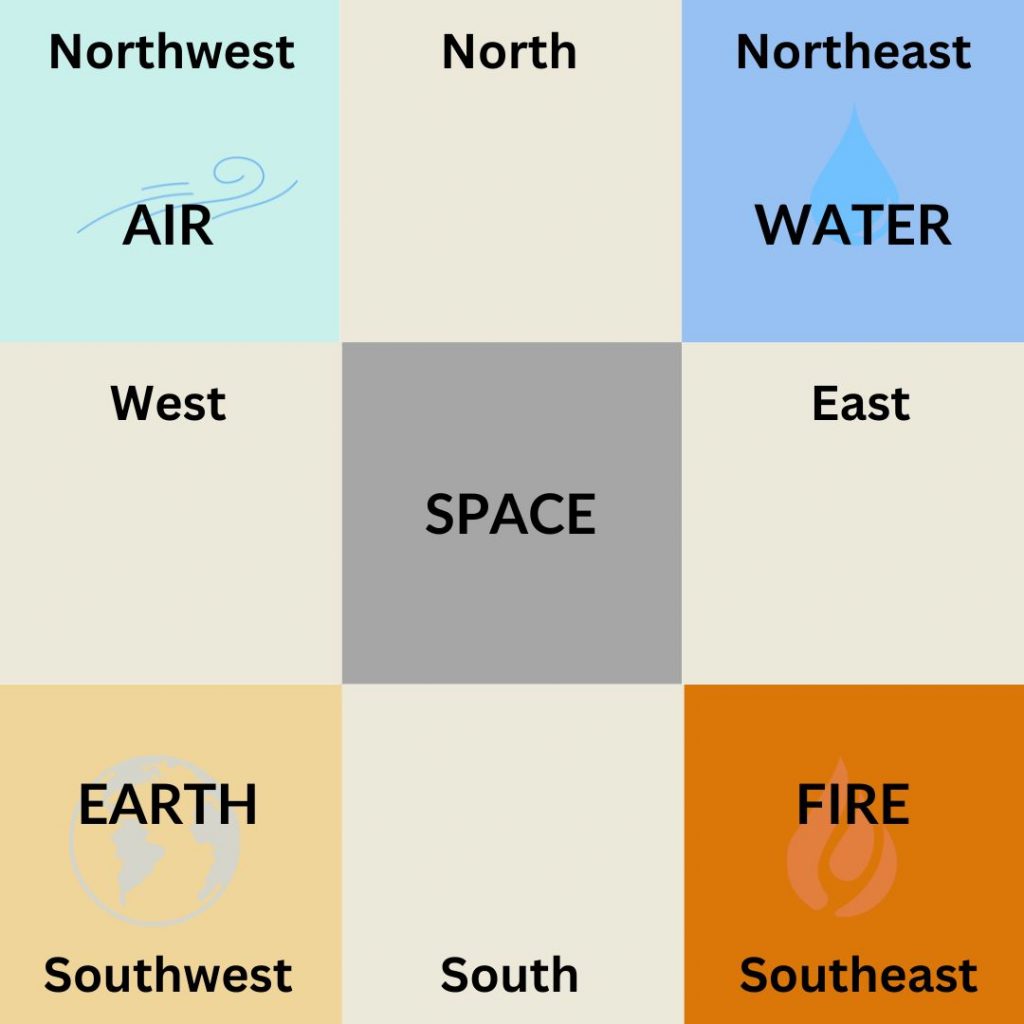
Vastu works with concepts such as Earth, Water, Fire, Air, and Space, known as the Panch Mahabhutas. Traditional Vastu teachings associate these elements with different directions and areas of a building.
Ayurveda also uses the concept of the five elements when describing the relationship between nature and the human body. This provides a traditional connection between the environment we live in and our personal wellbeing.
CREATING A HEALTH-SUPPORTVE HOME
A balanced home should provide good natural light, fresh air, comfortable temperatures, appropriate moisture levels, peaceful surroundings, cleanliness, and functional spaces. These are also important considerations in modern healthy-building and architectural design.
From a Vastu perspective, maintaining harmony between different elements and directions is considered important for creating a supportive living environment. Yogiraj Sri therefore examine the orientation, room placement, entrances, open spaces, and other features of a home when assessing its overall balance.
VASTU, AYURVEDA AND WELLBEING
The connection between Vastu and Ayurveda can be understood as a traditional approach to environmental and personal balance. Vastu focuses on the space around us, while Ayurveda focuses on the individual and lifestyle.
Together, they encourage us to pay attention to the relationship between our home, our habits, nature, and our overall wellbeing.
A thoughtfully designed home can be a place that supports healthy routines, comfort, relaxation, connection, and a better quality of everyday life.
Toronto Vastu Consultant Online
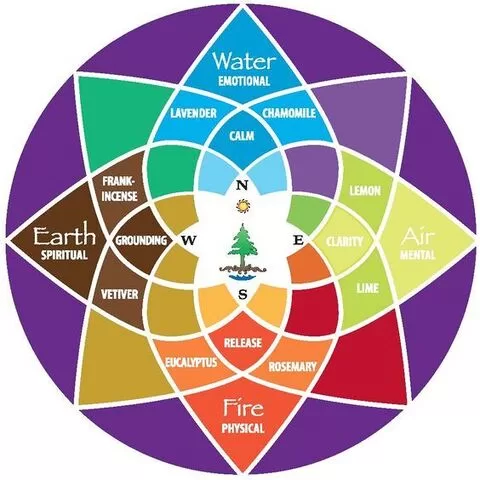
Vastu Shastra, Ayurveda and the Significance of Panchamahabhutas
Vastu Shastra and Ayurveda share an important traditional concept—the Panchamahabhutas, or five great elements: Earth, Water, Fire, Air, and Space (Ether).
In Vastu, these elements are used to understand the qualities of different directions and spaces within a building. In Ayurveda, they form part of the traditional understanding of the human body, its functions, and its relationship with nature.
When viewed together, these five elements provide a traditional way of understanding the connection between our surroundings and our wellbeing.
EARTH – PRITHVI
Earth represents stability, strength, support, and grounding. In Vastu, it is associated with stable and substantial spaces. In Ayurveda, Earth is traditionally connected with physical structure, including bones, muscles, and tissues.
WATER – JAL
Water represents nourishment, flow, purity, and adaptability. Vastu associates water with certain directional qualities and prosperity. Ayurveda connects the Water element with bodily fluids, nourishment, and the maintenance of physical balance.
FIRE – AGNI
Fire symbolizes energy, transformation, warmth, and activity. In Vastu, it has an important relationship with spaces associated with heat and cooking. In Ayurveda, Fire is traditionally connected with digestion and metabolism.
AIR – VAYU
Air represents movement, circulation, and activity. In Vastu, it relates to ventilation, airflow, and movement within a space. Ayurveda traditionally associates Air with bodily movement and functions related to the nervous system.
SPACE – AKASHA
Space represents openness, expansion, and the room in which all other elements exist. In Vastu, open and uncluttered areas can help create a feeling of spaciousness. In Ayurveda, Space is traditionally associated with body cavities, subtle processes, and consciousness.
CREATING BALANCE BETWEEN HOME AND WELLBEING
The Panchamahabhutas provide a common traditional framework for both Vastu Shastra and Ayurveda. Vastu focuses on the balance of these elemental qualities within the built environment, while Ayurveda considers them in relation to the individual.
A thoughtfully designed home can support everyday comfort through natural light, fresh air, appropriate ventilation, comfortable spaces, greenery, water, and suitable materials.
The traditional idea is simple: when our living environment is harmonious with nature, it can create a more comfortable and balanced setting for everyday life.
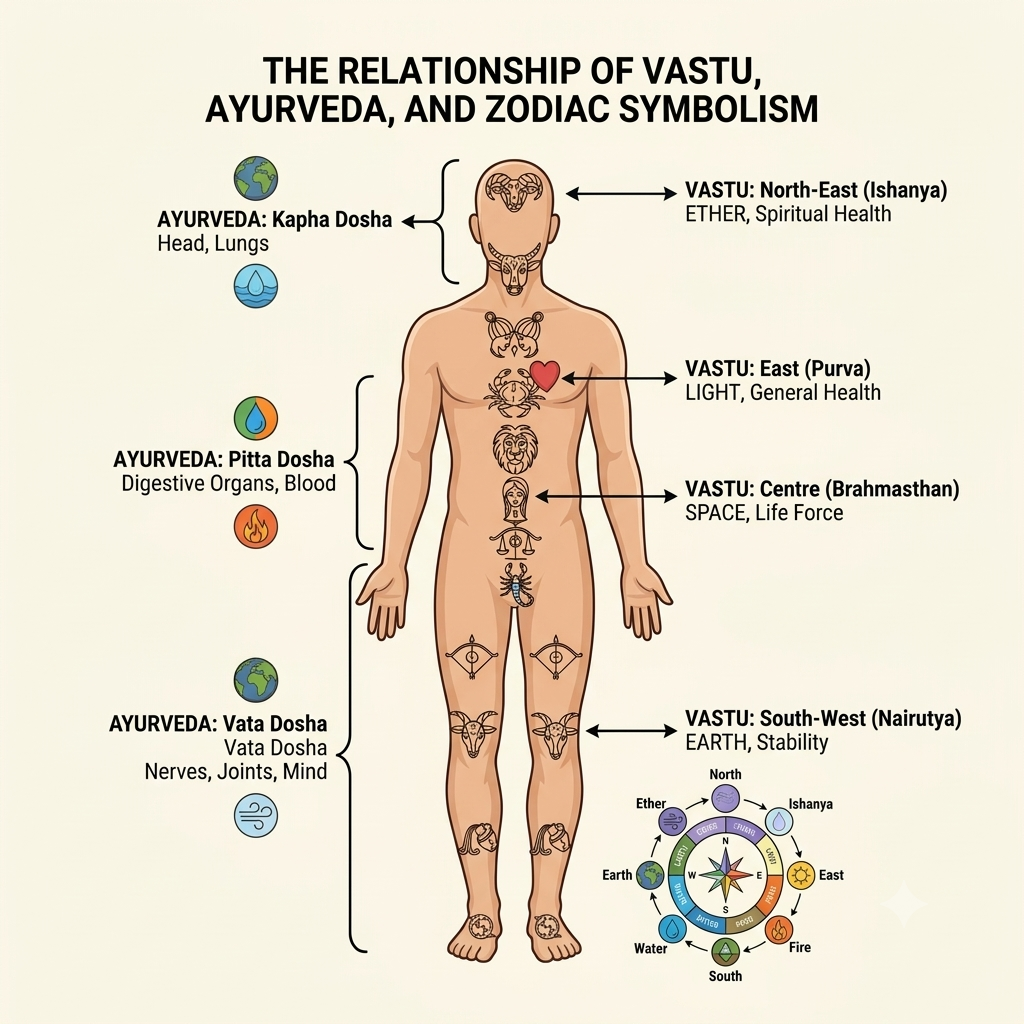
Ayurvedic Principles in Vastu
Ayurveda and Vastu Shastra both recognize the importance of our relationship with the natural environment. Ayurveda traditionally looks at the balance of qualities within the individual, while Vastu focuses on creating harmony within the spaces where we live and work.
This connection can be understood through the Panchamahabhutas and the three Ayurvedic Doshas—Vata, Pitta, and Kapha.
VATA – AIR AND MOVEMENT
Vata is traditionally associated with Air and Space, movement, lightness, and activity. A home that feels excessively drafty, dark, unsettled, or poorly organized may be considered unsuitable for Vata balance.
Traditional Vastu approaches may recommend improving natural light, maintaining comfortable airflow, reducing unnecessary clutter, and creating a calm and stable environment.
PITTA – FIRE AND TRANSFORMATION
Pitta is traditionally associated primarily with Fire and Water and qualities such as heat and transformation. Excessive heat, strong sunlight, or an unsuitable arrangement of fire-related spaces may be considered when assessing a home from this perspective.
Traditional Vastu practices may introduce cooling and calming features such as appropriate water elements, plants, lighter colors, shade, and improved ventilation where suitable.
KAPHA – EARTH AND WATER
Kapha is traditionally connected with Earth and Water, representing stability, heaviness, nourishment, and calmness. Excessive dampness, stagnant air, darkness, or accumulated clutter may be viewed as creating an overly heavy atmosphere.
Improving ventilation, introducing natural daylight, keeping spaces clean and organized, and using lively yet comfortable colors can help create a lighter and more refreshing environment.
CREATING A BALANCED HOME
The purpose of incorporating Ayurvedic ideas into Vastu is to encourage greater awareness of the relationship between people, their homes, and nature.
Rather than applying the same remedy to every property, each home can be considered according to its orientation, climate, ventilation, daylight, materials, room functions, and the preferences of its occupants.
These Ayurvedic and Vastu concepts are traditional frameworks and should complement, rather than replace, appropriate medical care, healthy lifestyle practices, and sound architectural design.
Ayurveda Principles with Planets & Zodiac
- Planet Sun: Head, Spinal cord, Brain, Heart, Right eye, Stomach, Thirsty feeling, Bones, Ring Finger.
- Planet Moon: Mental strength, Left Eye, Blood circulation, Breasts, Belly, Containers of various liquids, Cold Cough, Womb
- Planet Mars: Bone, Nails, Eyelid, Teeth, Ribcage, Skull, Blood cells, Cut injuries
- Planet Mercury: Skin, Nerves, Neck, Tongue, Forehead, Little finger, Shoulder, Throat
- Planet Jupiter: Vital organs, Boneless organs, Thigh, Nose, Ear, Intestine
- Planet Venus: Face, Hormone, Vision, Diabetes, Skin pigment, Genital organ
- Planet Saturn: Right ear, Chin, Below the hip, Below knee, Middle finger, Rheumatism, Acidity, Digestion problem
- Planet Rahu: Lips, Left ear, Intestine, Anus, Distortion, Poison, Chemicals, Laser, X-ray
- Planet Ketu: Hair, Small nerves, Veins, Anus, Beard, Tumour, Cuts, Bandages, Endoscopy
TORONTO VASTU ARCHITECT & VASTU CONSULTANT ONLINE
Vastu Architect and Astrologer Yogiraj Sri Sandeep Singh
is with a singular mission:
for TOTAL WELL BEING OF THE WORLDS.
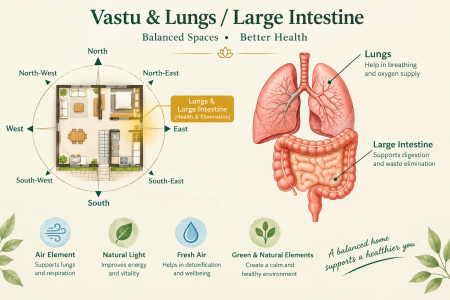
LUNGS AND LARGE INTESTINE
In traditional Ayurveda, the lungs and large intestine are associated with breathing, elimination, and the body’s ability to release what is no longer needed. The lungs are also traditionally connected with Prana, the vital life force associated with breathing and circulation.
From an emotional perspective, these organs are often linked with the ability to release and let go. In traditional Ayurvedic thinking, emotions such as grief and sadness are commonly associated with the lungs.
THE ELEMENT OF SPACE
Ayurveda traditionally relates the lungs to the qualities of Space (Akasha), which provides room for movement and circulation. Vastu Shastra also gives importance to the Space element when considering openness and movement within the built environment.
Traditional Vastu systems associate the Space element with areas toward the West and North-West. These areas may therefore receive particular attention during a Vastu assessment.
LUNGS, LARGE INTESTINE AND EMOTIONAL WELLBEING
Traditional Ayurvedic teachings associate the lungs and large intestine with grief, sadness, and the process of letting go. This symbolism can provide a meaningful way to reflect on how our emotional experiences and surroundings influence our perception of wellbeing.
However, emotional distress and respiratory or digestive symptoms can have many causes.
CREATING A HEALTHIER LIVING ENVIRONMENT
From both architectural and Vastu perspectives, the West and North-West can be evaluated for ventilation, cleanliness, clutter, moisture, drainage, waste management, and overall spatial quality.
A well-maintained home with fresh air, appropriate daylight, good hygiene, effective drainage, and organized spaces can provide a more comfortable environment for everyday living.
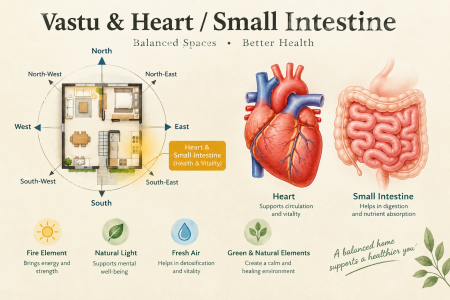
HEART AND SMALL INTESTINE
In traditional Ayurvedic, the heart holds a special place among the body’s organs. It is associated with vitality, circulation, emotional wellbeing, and the flow of life energy. The small intestine is traditionally considered its paired organ.
THE FIRE ELEMENT
Ayurveda traditionally associates the heart with the Fire element (Agni), representing warmth, transformation, activity, and energy. The small intestine is also closely connected with the traditional concept of digestion and transformation.
Vastu Shastra similarly gives an important place to the Fire element. The South-East, extending toward the southern part of a property, is traditionally associated with fire and heat-related activities.
This creates a traditional connection between the heart, small intestine, Fire element, and the South-East zone of a home.
SOUTH-EAST AND SOUTH IN VASTU
During a traditional Vastu assessment, the South-East area may be examined for its use, layout, and elemental balance. The kitchen is commonly recommended in the South-East because cooking naturally involves heat and fire.
DIGESTION AND ENERGY
Traditional Ayurveda places considerable importance on digestion and the body’s ability to transform food into nourishment.
A well-designed home can support healthy living through good ventilation, natural light, comfortable temperatures, hygienic cooking areas, and spaces that encourage healthy daily routines.
THE HEART AND THE EMOTION OF JOY
In traditional Ayurvedic symbolism, the heart is associated with joy, love, contentment, and emotional openness. A peaceful and uplifting home can contribute to a positive everyday atmosphere. Stress, emotional difficulties, and lack of wellbeing can have many causes and should not automatically be attributed to the design or direction of a home.
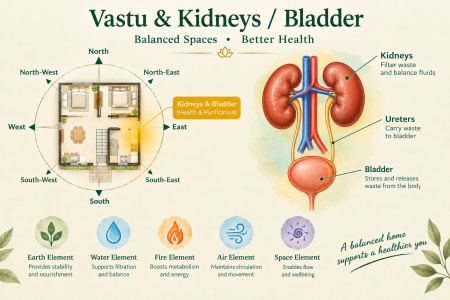
KIDNEYS AND BLADDER
The kidneys and bladder play essential roles in the body’s urinary system. The kidneys filter waste from the blood, help regulate fluids and electrolytes, and contribute to maintaining healthy blood pressure and other important body functions.
In Ayurveda, the kidneys and bladder are associated with the Water element and with the body’s processes of fluid balance and elimination. Water represents movement, nourishment, cleansing, and flow.
THE WATER ELEMENT
The Water element is traditionally associated with qualities such as fluidity, adaptability, nourishment, and purification. Because the kidneys are involved in filtering and regulating fluids, Ayurveda traditionally connects them with these water-related qualities.
Vastu Shastra also gives particular importance to water and its appropriate placement within the built environment.
NORTH AND NORTH-EAST IN VASTU
Vastu associates the North and North-East with water-related qualities. During a Vastu evaluation, features such as toilets, kitchens, septic systems, drainage, water storage, and other utilities may be reviewed carefully in these zones.
Traditional Vastu practices may recommend keeping the North-East relatively clean, open, and light. Water features may sometimes be suggested as a symbolic Vastu measure, but they should only be introduced when they are practical, hygienic, and appropriate for the property.
KIDNEYS, BLADDER AND EMOTIONAL WELLBEING
Ayurveda associate the kidneys with the emotion of fear. This symbolic connection is sometimes used to encourage reflection on emotional wellbeing and the importance of creating a calm living environment.
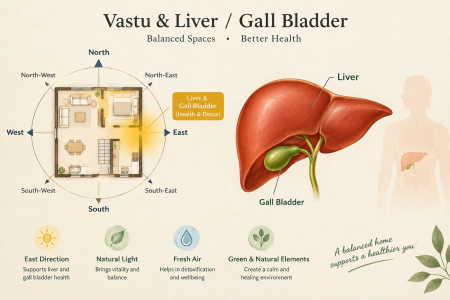
LIVER AND GALL BLADDER
The liver is one of the body’s major organs and performs many important functions, including processing nutrients, producing essential substances, and helping remove waste from the body. The gall bladder supports digestion.
In Ayurveda, the liver and gall bladder are associated with processes of transformation, circulation, and emotional balance. The liver is also symbolically connected with the ability to manage and release strong emotions.
THE ELEMENT OF AIR
In Ayurveda and Vastu, it uses the five elements to describe relationships between the body and the environment. The Air element is associated with movement, activity, and circulation.
Vastu traditionally gives importance to the East and South-East areas of a property when considering certain elemental and functional relationships.
EAST AND SOUTH-EAST IN VASTU
During a traditional Vastu assessment, the East to South-East zone may be examined for its layout, cleanliness, ventilation, and the placement of utilities. Features such as toilets, septic systems, drainage, or unsuitable structural elements may be reviewed carefully in this area.
THE LIVER AND EMOTIONAL WELLBEING
In traditional systems, anger and irritation are often symbolically associated with the liver. This idea encourages awareness of how we respond to stress and emotional experiences.
If a person frequently experiences anger, irritability, or difficulty managing stress, it is helpful to consider lifestyle, relationships, sleep, work pressures, and emotional wellbeing rather than attributing these feelings solely to the home.
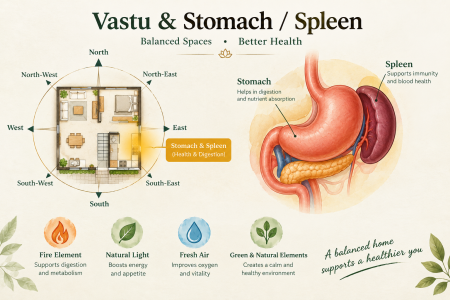
STOMACH AND SPLEEN
The stomach and spleen are important organs with different roles in the body. The stomach helps digest food, while the spleen supports immune function and helps filter blood.
In Ayurveda, these organs are associated with the Earth element, which represents nourishment, stability, strength, and support. Just as the earth provides a foundation for growth, the traditional concept of Earth represents the qualities needed for nourishment and stability.
THE EARTH ELEMENT AND SOUTH-WEST
Vastu Shastra traditionally associates the South-West with the Earth element. This direction is considered a grounding and stable part of the home and is often given importance when planning bedrooms, storage, and other spaces requiring stability.
DIGETSION AND NOURISHMENT
The stomach plays an important role in breaking down food and beginning the digestive process. Ayurveda traditionally places considerable importance on digestion as part of overall wellbeing.
WORRY AND EMOTIONAL WELLBEING
The Ayurveda associate the stomach with worry, anxiety, and overthinking. This provides a symbolic reminder that emotional wellbeing and physical wellbeing are closely connected in our daily lives.
TORONTO VASTU CONSULTANT ONLINE FOR VASTU SOLUTIONS & WELLNESS ARCHITECTURE
Vastu Architect & Astrologer Yogiraj Sri